If you’re a history buff, an archaeology enthusiast, or you simply want to learn something new, this one’s for you! Greece boasts numerous archaeological treasures, such as the Acropolis, Delphi, and Olympia. While some attractions get world-wide attention, many are overshadowed.
Why not make your Greek holiday just a bit different and more meaningful? Here is our pick of the best ancient sites in Greece that you probably haven’t heard of in well-known destinations:
1. Akrotiri, Santorini

Amidst the multi-coloured cliffs of Santorini, south of Oia and Fira, lies the prehistoric settlement of Akrotiri. Home to the ancient Minoans, the impressive site stems from the Bronze Age. It was a prominent port town in the Aegean until it was covered by volcanic ash, after an eruption by Thera in the 17th century BC. It is hence referred to as the Greek Pompeii.
- Although ruined, the site remains one of the best ancient sites in Greece, boasting archaeological wonders from a once sophisticated, prosperous settlement that had multi-storey buildings, and even a developed sewage system.
- Remnants include everyday items such as Minoan toilets, stone bathtubs, pottery, and painted frescos.
How to Visit Akrotiri Greece?
Once in Santorini, Akrotiri is about 12 kilometers from the main town of Fira. You can rent a car, take a taxi, or use the local bus service, which runs frequently between Fira and Akrotiri. Many guided tours also include transportation to and from the site, providing an easy and informative option.
Pro Travel Tip
- You can explore the marvel of Akrotiri today via walkways that are suspended above the ruins. If it gets too hot, Red Beach is only a short walk away!
- Also, the Museum of Prehistoric Thera in Fira houses many of the artifacts from Akrotiri. Visiting both the site and the museum provides a comprehensive understanding of the Minoan civilization.
2. Skarkos, Ios

If you’re in need of a break from partying, Skarkos deserves a visit. Like Akrotiri, Skarkos was a flourishing Bronze Age settlement; urban and complex, but 1000 years older! Found north of Ios port, it was built in a circular shape on an imposing hilltop.
Only recently discovered in the 1980s, ceramic objects, tools, and figurines were excavated. Yet most impressive, is that you can still see housing structures such as doorways, ground floors, and stairways today!
How to Visit Skarkos Greece?
Skarkos is located near the island’s main town, Chora. The site is easily reachable by car, taxi, or even a short hike from Chora, which is approximately 2 kilometers away. Public transportation options, such as local buses, also service the area, providing another convenient way to get to the site.
Pro Travel Tip: Hike to the top of this unique settlement and witness fantastic views of the coastal plain!
3. Tower of The Winds, Athens

This beautiful structure literally stands in the shadow of the Acropolis, untouched and continuously functional! Built around the 50th century BC from Pentelic marble, the ancient tower was constructed to indicate and forecast the weather with sundials, wind vane, and water clock.
It was also used to estimate time. Each wall of the octagonal tower is adorned in carvings personifying the eight winds. The well-preserved building fascinated many, inspiring numerous structures around the world.
How to Visit the Tower of the Winds?
The Tower of the Winds is easily accessible from various parts of the city.
- By Metro: The nearest metro station is Monastiraki, which is a short walk from the site. Monastiraki Station is on Line 1 (Green Line) and Line 3 (Blue Line) of the Athens Metro, making it convenient for travelers coming from different parts of the city.
- By Bus: Several bus routes pass close to the Roman Agora. Check the local bus schedules for the best routes from your location.
- On Foot: If you’re staying in central Athens, walking is a pleasant option. The Tower of the Winds is located near other famous landmarks like the Acropolis, making it easy to incorporate into a walking tour of the city.
Pro Travel Tip
The Tower of the Winds is close to other major attractions like the Acropolis, the Ancient Agora, and the Plaka district, making it easy to explore multiple sites in one day!
4. Theatre of Dionysus, Athens

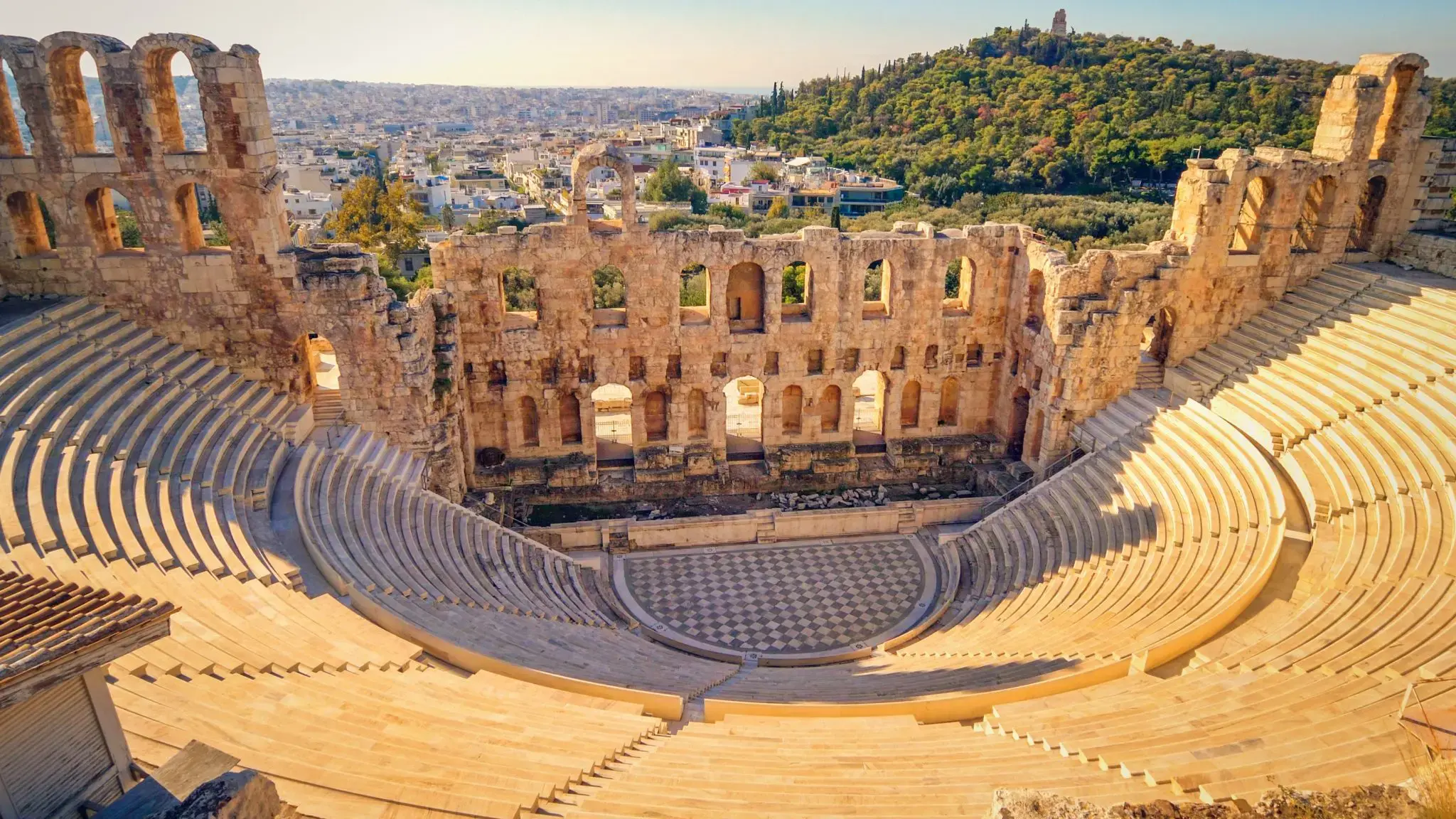
Even though it may be the first theatre ever constructed, these ruins are often disregarded. Situated along the slopes of the famous Acropolis, it was only rediscovered during the 1700s. With tiered seating centred around a rectangular stage, the theatre could hold an audience of about 17,000 people.
Here, Greeks enjoyed theatrical performances, festivals, and religious practices dedicated to the god of wine and ecstasy, Dionysus. It is also recognised as the birthplace of Greek tragedy.
- Upon entering, you’ll be transported back to ancient Greece, standing where audiences once witnessed the plays of Aeschylus, Sophocles, Euripides, and Aristophanes.
How to Visit the Theatre of Dionysus?
By Metro: The closest metro station is Acropoli on Line 2 (Red Line). From there, it’s a short walk to the theatre, passing by the Acropolis Museum.
By Bus: Several bus routes stop near the Acropolis and the Theatre of Dionysus. Check local schedules for the best options.
On Foot: If you’re staying in central Athens, walking to the Theatre of Dionysus is a pleasant option, especially from areas like Plaka, Monastiraki, and Syntagma Square. The walk allows you to enjoy the charming streets of Athens and other nearby historical sites.
5. Little Metropolis Church, Athens

This small, charming church nestled in the heart of Athens goes largely unnoticed as it is overshadowed by grander surrounding spectacles.
Also known as the Church of St. Eleutherios or Panagia Gorgoepikoos, the church is a unique Byzantine structure. It is almost entirely erected from “spoila”, which is previously used building material.
Its beautiful stonework has thus created a confusion of when exactly the church was built. Yet, it persists as a sacred marvel considering it has remained completely intact since it was first constructed.
How to Visit Little Metropolis Church?
By Metro: The closest metro station is Syntagma on Line 2 (Red Line) and Line 3 (Blue Line). From Syntagma Square, it’s a short walk to the church.
By Bus: Numerous bus routes stop at Syntagma Square. Check local schedules for the most convenient options.
On Foot: If you are exploring central Athens, the Little Metropolis Church is easily accessible on foot from other major attractions like the National Garden, the Greek Parliament, and the Ermou Street shopping district.
Pro Travel Tips
- Respectful Attire: As with all places of worship, modest clothing is recommended out of respect for the religious nature of the site.
- Photography: While photography is usually allowed, it’s polite to be discreet and avoid using flash to preserve the delicate frescoes and icons.
FAQ – Visiting Ancient Sites in Greece

Spring (April to June) and Fall (September to October) are ideal due to mild weather and fewer crowds.
Summer (July and August) can be very hot and crowded, but it’s still a popular time for tourists.
Winter (November to March) offers fewer tourists, but some sites may have reduced hours.
Wear comfortable walking shoes, as many sites have uneven terrain and require extensive walking.
Dress in layers and bring a hat, sunscreen, and water, especially in the summer.
Acropolis of Athens: Iconic ancient citadel featuring the Parthenon.
Delphi: Sanctuary and oracle site dedicated to Apollo.
Olympia: Birthplace of the Olympic Games.
Epidaurus: Famous for its well-preserved theater.
Knossos: Largest Bronze Age archaeological site on Crete, associated with the Minoan civilization.
Mycenae: Ancient city known for its lion gate and royal tombs.
Athens is widely regarded as the city with the most history in Greece. As the cradle of Western civilization and democracy, Athens boasts a rich historical tapestry that spans thousands of years. The city is home to iconic ancient landmarks such as the Acropolis and the Parthenon, which are testaments to its glorious past.
Greek mythology is deeply woven into the fabric of Greece and can be seen throughout the country. Ancient sites, such as the Temple of Zeus in Olympia, the Temple of Apollo in Delphi, and the Palace of Knossos in Crete, are all connected to legendary myths and deities. In Athens, the Acropolis and its monuments are dedicated to gods like Athena and Poseidon.
Are you feeling inspired? Discover and fall in love with these gems on our Greece tours! Book today and save up to 50% OFF!